Hilton Head Island was captured by Union forces on November 7, 1861 after the Battle of Port Royal. The enormous amphibious invasion force, the largest until World War II, consisted of 77 ships (15 warships), 13,000 troops, 1,500 horses and tons of materials needed to establish the headquarters for the South Atlantic Blockading Squadron.
Three years later Fort Howell was built by black Union Army troops to protect Mitchelville, the first town in the South developed specifically for the thousands of newly freed slaves.
Fort Howell historic site is located near the intersection of Beach City Road and Dillon, right across from Hilton Head Airport. Admission is free, the site is open daily from dawn to dusk and it takes about 15-20 minutes to cover all the grounds.
Fort Howell full layout
Fort Howell historic highlights:
• The earthen fort was named after Gen. Joshua Howell, who was killed in the battle of Richmond.
• The newly arrived 500 members of the 32nd U.S. Colored Regiment from Pennsylvania, under the command of Col. Baird and the 144th New York Infantry, were assigned the task of building the fort.
• Fort Howell was built in the middle of a large cotton field near the Port Royal Sound, on 3 acres of land once part of the Fish Hall Plantation of William Pope.
• It was designed for 27 guns, 11 field pieces and 16 siege guns.
After building the fort, the 32nd U.S. Colored Regiment participated in the Battle of Honey Hill, on November 30, 1864, sustain 51 casualties.
Traverse and moat
The first black troops in the Union Army enlisted on Hilton Head Island in 1862. Initially, men were reluctant to join the army, not wanting to leave their families and risk being captured by the Confederates which meant a return to slavery and death. Also, many Union troops were openly hostile to escaped slaves. To encourage recruits Gen. Hunter issued a pass to those joining the army:
“Now, be it known to all that, agreeable to the laws, I declare the said person free and forever absolved from all claims to its services. Both he and his wife and his children have full right to go North, South, East, West as they may decide.” D. Hunter Major General Commanding. April 19, 1862.
North Bastion location
The unit was disbanded months later. Congress did not allow black men to serve until 1863, when the unit was officially organized as the South Carolina First Regiment. The men in the unit were former slaves from South Carolina, Georgia and Florida.
By the end of the Civil War, 179,000 blacks in the Union Army and 20,000 in the Navy have fought for freedom and the end of slavery.
What remains from Fort Howell’s earthen fortifications
Peaceful trail withing Fort Howell historic site
More historic sites in the area (data and map from Historical Markers Database website)
• Mitchelville site
• St. James Baptist Church
• Battle of Port Royal
• Fish Hall Plantation
• Thomas Fenwick Drayton
• Two Gallant Gentlemen from South Carolina
Here is the map, all markers are within 1 mile from Fort Howell and have free admission.
Need a break from the heat? Head to Saluda Shoals Park halfway between St. Andrews Rd and Lake Murray Blvd) for the coolest water playgrounds in the Midlands!
The zero-depth pad is perfect for little kids to splash about to their hearts’ delight. The Splash Park is open daily 9AM to 8PM through Labor Day. An all day play $3 wristband can be purchased at the gate (credit cards accepted). Park admission is $5 per car / $7 per van / $10 per bus.
The are restrooms, vending machines, a covered shelter with picnic tables and grills (available for rental) and a covered playground.
I’ll the photos do the talking:
Pour some fun this summer at Saluda Splash pad!
A dash of splash for everyone
Water logged? Take it down a notch at the covered playground behind the splash pad.
Have a splashing summer in Columbia, South Carolina!
We finally got to see the baby Galapagos tortoises that came with a big bang last fall. They are adorable…tiny and clumsy on their little feet, is hard to believe they will grow to weigh almost a ton! The hatchlings are on display inside the Aquarium, and as a bonus, next to them is a pair of Komodo Dragons juveniles that were born at the Los Angeles Zoo.
Biggest surprise of the century! 100 years old Galapagos turtles giving birth at Riverbanks Zoo.
Here are the proudest parents at the zoo: mom, Alberta, came to the United States in 1951 as an adult and dad, Abrazzo, arrived in 1928, also as an adult. Riverbanks Zoo acquired the pair in 1995. Both are believed to be over 100 years old…love is truly timeless.
At the SC State Museum we recently enjoyed seeing the “Tangible History:
The Potter's Wheel demonstration: making a funny face jug using traditional pottery tools
South Carolina Stoneware from the Holcombe Family Collection” exhibit (free with museum admission which is $7 adults, $5 children 3-12).
The best part was the live demonstration with a treadle potter’s wheel, an exact replica of the one used by Billy Henson from the Clayton Pottery Shop in 1940s.
The collection features exquisite stoneware from the old Edgefield district by makers such as Thomas Chandler and Dave the Potter, a famous African-American slave artist.
There is also significant pottery from the Upstate, like the Owensby, Whelchel and Williams Pottery Shops.
Stoneware is fire-hardened clay, that becomes as hard as stone after being heated to about 2,000 degrees. It is highly collectible, especially Edgefield pottery, well-known for its unique alkaline glaze.
The South Carolina stoneware heritage...a potter's treadle wheel
Native American cooking vessel c. 1000 from the Savannah River area
My daughter and I had great time visiting the McMillan Greenhouse inside Charlotte Botanical Gardens (located on the east side of the university’s campus). We spent couple hours browsing, touching, smelling, gasping and laughing at the weirdest, funniest and most bizarre plants from around the world. The greenhouse has several rooms: Carnivorous, Orchids, Cactus, Dinosaurs (yeah that’s right!), and Tropical. Admission is free and the greenhouse is open daily 10AM-3PM (1-4PM on Sunday).
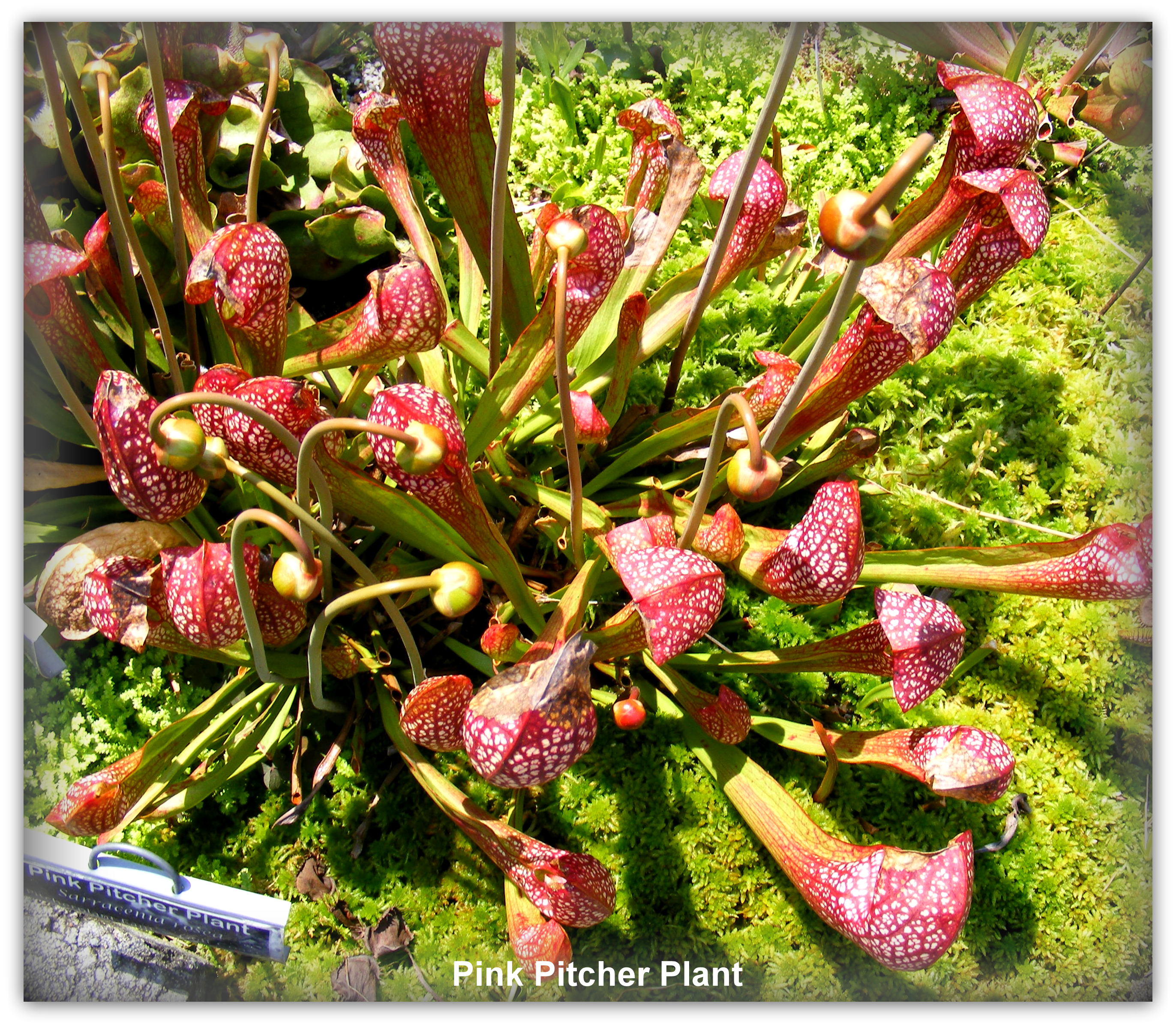
This post features the “ferocious” carnivorous plants: Venus flytrap, Pink pitcher, Lovebug Sarracenia Hybrid and the Monkey Cups.
My daughter pleaded for a Venus flytrap ($8 for sale).
Our little flytrap: Dionaea Muscipula...sounds fierce!
Interesting facts:
• Venus flytrap lives only on the coast of North and South Carolina
• Venus Flytrap feeds on insects, yet big plants can catch and digest small frogs. It uses its bright red pigmentation to attract prey.
• The trap shuts in 0.3 seconds (one of the fastest plant movements in the world!) To avoid energy waste the trap snaps only after the trigger hairs have been stimulated twice within few seconds.
• It takes several days for the plant to completely digest an insect, and reopen its trap. Smaller insects sometimes escape despite a highly evolved grid of teeth that interlock when the trap closes.
• A trap is only good for 4 to 6 catches. After that, the trap withers, turns brown, and falls off. Read more and see a frog capturing video here.
When we got home we transferred the plant into a bigger pot (thanks to the wonderful staff we got free peat moss soil, which is best for Venus flytrap) with a large saucer and set it on the outdoor table in full sun. Within days she got to work, and caught three insects! All we had to do is give it water every day.
Few days later, she caught a large mosquito and a couple of flies. Bravo!
The pitcher plants lure insects inside their specially designed leaves with pretty colors and sweet scents. The inner walls are slippery trapping most of the intruders for good. As victims accumulate in the depths of the pitcher, digestive juices are secreted that liquify the prey for absorption.
Pretty in pink, yet lethal
Monkey Cups is a tropical pitcher plant that lives in South China, Indonesia, Malaysia, Borneo, Sumatra, Madagascar, Seychelles and Australia. As the name suggests monkeys use them as drink fountains.
The monkey cups plant gets many visitors, some just looking for an easy meal inside the pitcher.
What love got to do with it?
Interested to start your own bog garden? The McMillan Greenhouse has all you need: plants, knowledge and friendly staff on hand.
Cute as a bog garden? Pretty little eaters...
Don’t forget McMillan’s biggest plant sale of the year will take place April 20 and 21st, 2012 8AM-3PM at the greenhouse.
The most destructive earthquake ever recorded in the eastern United States occurred near Charleston at 9:51PM on August 31st, 1886. The quake was felt by two out every three people living in the country! Estimated at a 7.3 magnitude (more powerful than the Haiti earthquake in 2010) the shock lasted about a minute.
According to the Savannah Morning News, at least a dozen people went insane and had to be sent to lunatic asylums, including “the wives and daughters of prominent citizens.”
“A drugstore clerk started walking on Tuesday night and didn’t stop until he reached a town fifty miles away, where he sent a postcard to his parents saying he could not return.”
Earthquake damage throughout United States:
• Maine: The captain of a schooner off the coast saw “black wall” rising on the water, a mighty wave that lifted the ship to a fantastic height. The schooner was buried in a mountain of foam, its sails torn off and its mast snapped.
• North Carolina Mountains: Flames shot from caverns, leaving behind a cloud of smoke that smelled like burning coal. Massive rocks crashed down into the valley.
• Brooklyn, New York: A telephone operator thought he was having a heart attack when all the plugs on his switchboard popped out of their sockets.
• Terre Haute, Indiana: At a minstrel show the galleries swayed, and one man was thrown out of the balcony; he saved himself by clinging to a railing.
• Dubuque Iowa: The audience in the opera house stampeded, thinking the building was about to fall.
"People ran through the streets...bare feet cut by broken glass and brick shards. Fires raged across the city."
Earthquake damage in South Carolina
• Dorchester County: Every structure in town was damaged. “…the structure seemed to dance up and down…The doors and ceilings were warped and twisted; the timbers groaned and crackled; the chimneys crashed at their bases, sank downward, carrying fireplaces, mantles and hearthstones through the floors through the ground below.” U.S. Geological Survey final report.
• Horse Creek, Aiken County: A train pulling stock cars plunged off the tracks into 40 feet of water. The fireman was killed and four horses drowned. Other animals kicked holes in the cars and swam to safety.
• Adams Run, Charleston County: 20 feet high geysers covered the ground hip-deep with water.
• Ravenel, Charleston County: The ground broke open for 2.5 miles. A man trying to reach his grand-children was cut off by a jet of water.
Shock and awe
Within days almost everyone in Charleston abandoned his damaged home to sleep outside, in parks, cemeteries, backyards, on buses, ships, ice wagons, and railroad cars. Ships in the harbor became refugees for the homeless.
Building completely destroyed by the earthquake
By September 3rd, 40,000 people were tenting and encampments bloomed on every piece of open ground. Many families returned to their houses only to flee back when aftershocks struck.
At first black and whites shared the camps, but soon whites moved away from integrated areas like Washington Square Park and congregated instead at White Point Garden by the Battery.
The state government never provided relief money or supplies. After more than a week the city began to erect wooden shelters and substantial tents sent by other states and the U.S. military.
Where is disaster there is also opportunity…
• Within days a large number of tourists from as far away as Boston came to see the wreckage. Railroads scheduled a variety of excursions and sometimes donated funds to the relief effort. On September 12, 1550 visitors arrived from Georgia and Florida, 400 of whom stopped to eat dinner in the city’s big hotels. Most wary of the aftershocks got back on their trains and left before dusk.
• Businessmen scrambled to serve the tourists: stores offered booklets showing the damage, some sold vials of the brightly colored sand and clay brought up by sand blows.
'Earthquake Views...Not an advertising scheme'...yeah right!
When those ran out they filled glass tubes with coffee grounds and red pepper flakes.
• One antique dealer ran ads seeking door knockers, candlesticks and other artifacts that survived the quake to sell to “Northern parties”.
• Agents for dime museums were said to be in town looking for “earthquake babies” as special exhibits. Some twins born the night of the disaster were nicknamed Earth and Quake.
The biggest quake sham of all time!
Earthquake Ray-Charged Copper Battery made by J. M Brasington, Benetsville South Carolina, discoverer of Rays, 1890.
The maker, J.M. Brasington, contends that the battery will intercept and store earthquake rays from 10,000 miles away, and when connected to the body can cure a many illnesses.
How it Works (text from the battery label)
The Ray Charged Copper Battery scam of the late 1880s...
“The Battery trap intercepts rays from earthquakes; this stream of rays is the first entering the lower pure blood veins; the rays from the battery immediately enter the upper pure blood veins meeting the quake rays in the heart;
Then it seems million of battery and quake rays shoot out through all blood, flesh, nerves, bones and skin, strengthening the heart nerves, improving resistance to infestation, aiding appetite, digestion, inducing sleep and rest; helps to keep mentally tired man’s body youthful and vigorous.”
How to Use (text from the battery label) “When taking the hot or cold rays, the wrist band must be on the right or left wrist…Copper traps must be laced to slipper soles, stocking or bare feet. When wrists and straps are properly fitted you will get the Quake and Battery rays even if sitting on rubber, glass, riding in automobile, boat, lying on bed or couch.
Place Battery in any position best suited to your comfort; except the Battery must not be between your feet. While Battery is surrounded by your feet you will get no Earthquake Rays…”
Fun stuff for kids inside the SC State Museum Earthquake exhibit
Test your engineering and architectural skills at the large shake table to see whether you can build an earthquake proof building.
See whether you can build an earthquake proof structure
Check out the one of the base isolation pads used in the renovation of the SC State Capitol in the late 1990s. About $13 million was spent to make the building meet and exceed 20th century earthquake protection codes. A new base isolation system was created to absorb the energy of vibrations caused by earthquakes. 130 base isolation pads were installed to support the building, a first for a major structure building east of the Mississippi River. Nowadays computers monitor any shifts in the ground through these isolators.
The SC State Capitol was the first major building east of the Mississippi River to undergo a massive earthquake prevention renovation.
Learn how to be safe when the earthquake strikes: drop, cover and hold!
Drop, cover and hold!
See more exhibit details in the presentation below:
The book features Francis Warrington Dawson, editor of Charleston’s News and Courier, who rallied Charlestonians after the earthquake struck by organizing the relief committee and receiving contributions that helped rebuild the city. Hailed as a hero in the aftermath of the earthquake, Dawson was denounced by white supremacists and murdered less than 3 years after the disaster. His killer was acquitted after a sensational trial that unmasked a Charleston underworld of decadence and corruption.
Recently we visited the SC State Museum to see the renown Body Worlds exhibit. We took advantage of the special $1 admission (1st Sunday of the month) and ended up paying $20 total (adult and child tickets). We spent over an hour browsing the galleries and gift shop and we were impressed.
So excited to see this!
My 7 years old daughter became fascinated with the heart and the circulatory system (see cool facts below). She took the time to complete the survey and gave the exhibit a rave review.
Body Worlds tickets allow full day admission to the entire museum
• $18 adults ($8 members)
• $15 seniors ($7 members)
• $12 children 3-12 ($6 members)
Hours
• Tue 10AM – 8PM
• Wed,Thu and Fri 10AM – 5PM
• Sat 10AM – 6PM
• Sun 1 – 5PM
Body Worlds Vital is the latest installment in the Human Saga by Gunther von Hagens. It features 200 real body specimens, presented without skin using plastination, so you can see bones, muscles, tendons, nerves, blood vessels and all of the internal organs. You get a deep understanding of how the body works when is healthy and what happens when is sick. Smart displays drive the healthy lifestyle point home: respect your body or else.
In your face...smoking kills people!
Things to know before you go
• Come early. We arrived at opening time and got in real fast. Most importantly we were able to browse all the stations at our own pace, taking time to see the displays and read all the explanations. Two hours later there were at least 200 people in line waiting to be allowed in the exhibit…not to mention those waiting at the museum check-in line!
• Not sure whether this is right for you and the kids? Check out the exhibit video, Family Guide and FAQ provided by the state museum. There is enough visuals to help you decide.
• Tickets are non-refundable and are good for just one entry. The Body Worlds exhibit closes on April 15, 2012.
People lined up to see the remarkable Body Worlds Vital exhibit
Cool Body Facts
• At birth, humans have 300 bones. As a baby grows, however, many of the smaller bones fuse together so that adults have just 206 bones. Half of the bones are in the hands and feet.
• The brain uses 25% of the oxygen you take in. It transmits signals to the body at 100 miles an hour.
• Lungs are made up of about 600 million spongy bags called alveoli. Lungs are the only organs in the body light enough to float on water.
• If all the blood vessels were laid end to end, they would extend about 60,000 miles, far enough to circle the Earth twice.
We also enjoyed the Body Worlds gift shop, especially the pictures of plastinates from the animal kingdom. It’s fun to compare the inner workings of the human body to that of other animals.
This is how you do it
While inside the museum check out the 125th Anniversary exhibit of the Great Charleston Earthquake of 1886, the greatest quake ever recorded in the eastern United States (biggest than the one in Haiti!).
My first time seeing a bald eagle in the wild! We love kayaking in the marshes near North Myrtle Beach (Cherry Grove inlet to be exact) because is so peaceful and you get to watch a variety of wildlife in their natural habitat. This was indeed icing on the cake…
We started out at sunrise and let in at the boat ramp inside Cherry Grove Park adjacent the Heritage Shores Nature Preserve (highly recommending visiting , free admission).
Best way to start the day: going kayaking in the marsh at Cherry Grove Beach!
After a hearty 30 minutes paddle going against the current as we were trying to reach
Paddling through the side inlet to avoid going against the current
the ocean, we turned around looking for a better way.
We found it right across the dock where we let in. There is a mini inlet going parallel to main channel (Go only at high tide to avoid getting stuck in the sea grass or the oyster beds).
What a world of difference!
While my husband guided the kayak at a leisurely pace, I was able to take photos, enjoy the beautiful marsh views, and look out for wildlife.
We hit the jackpot! A remarkable American bald eagle perched on a pole,
Great reason to go out paddling...a chance to see the majestic American bald eagle!
scanning the marsh in search for a morning prey, oblivious to our presence…
For a long time it stood so still I wondered whether is one of those fake birds you see around the beach.
But it did eventually move when we got really close.
As I was shooting a video of its huge, beautiful wings in full strike, my batteries ran out…go figure! At least I got some nice still shots.
Here is another big bird beauty, a great white egret sitting in a tree in the middle of the preserve.
Great white egret trying to spot its next meal
A double crested cormorant gliding smoothly above the water. Did you know that cormorants dive for food and after catching a fish, resurface, flip it into the air and swallow it head first?
Rewarding wildlife viewing while paddling in the marsh
Our initial attempt to pass “the Gauntlet of Death” (the nickname my husband gave the spot where the inlet meets the ocean and strong waves push against you) failed. But our second try through the side inlet succeeded with ease. We reached the barrier island and decided to take a break.
Where the inlet meets the ocean at the "Gauntlet of Death"...
Another treat in store: bottlenose dolphins feeding offshore. During our extended winter vacation at Cherry Grove Beach we were lucky to see dolphins swimming by the pier almost every day. Here is a memorable video with a pair of dolphins doing a spectacular synchronized jump.
Enjoying a relaxing break from paddling on the barrier island
What else can you ask for? The ocean, sun, amazing wildlife encounters and a healthy dose of exercise at the beach, all free. Happy New Year everyone!
Gorgeous beach vista from the barrier island
Start a new family tradition this year: kayaking along the South Carolina coast!
Ever wonder what is like to be in the middle of a saltwater marsh? Visiting the Heritage Shores Nature Preserve is the perfect way to find out. The preserve is feet away from Cherry Grove Beach and provides a mile long roundtrip boardwalk through a beautiful and diverse ecosystem. Admission is free and the park is open all day year around.
How to get there and where to park: The Nature Preserve is located next to the Cherry Grove Park and Boat Ramp at the end of 53rd Avenue North. The park is a very popular fishing destination in North Myrtle Beach and most of its parking spots are designated to cars with boat trailers. The preserve has its own mini parking lot and from here talk the short walk to the preserve entrance (turn right, away from the boat ramp area).
Start of the 1 mile walking trail inside the preserve
There are many interpretive signs about the marsh, fauna and flora you can observe along the trail. There is a boating dock and two shaded picning shelters (no restrooms). Bicycles are not allowed inside the preserve.
Oyster reefs are nature’s purest water filters, capable of cleansing 10 to 15 gallons of water a day.
The purest water filter...
Bird watchers enthusiasts are in for a treat. You can often spot blue herons, brown pelicans, white ibis and great egrets. Occasionally you may see double crested cormorans, osprey, hawks and barred owls.
The king of the tidal marshes
A majestic looking brown pelican hunting for its next meal. When fishing pelicans dive bill first from up to 60 feet high. An air sack under the bill cushions the blow that will otherwise kill most birds. A pelican can live almost 30 years.
Master fisherman in action
Scenic picnic area overlooking the inlet and the ocean.
Picnic area overlooking the marsh and the Atlantic Ocean
Dogs on leash are welcome inside the preserve.
Walking the dog inside the preserve
The Cherry Grove Hog Inlet provides good fishing opportunities for silverside, winter flounder, mummichog, pinfish, Atlantic croaker and striped mullet.
A great way to spend the day in the tidal marsh
There are many different trees inside the maritime forest preserve. Here is an example of the sour cherry tree, where the Cherry Grove Beach name comes from. Other trees are the loblolly, red cedar (which is actually a juniper!), wax myrtle, groundsel and the strange looking hackberry.
There are indeed cherry trees at the beach...
My favorite was the Yaupon Holly, a very important tree for the Native American tribes that inhabited the area thousands of years ago. They used the caffeine-rich leaves for medicinal (“black drink” tea) and ceremonial purposes. Nowadays the berries are an important food source for many birds and small mammals.
Yaupon Holly tree at Cherry Grove Beach
Here is prickly pea cactus, nature’s own holidays ornament! Other plants include the Indian blanket, sea daisy, goldenrod (another popular medicinal plant used by Native Americans to treat fever, coughs, colds and measles), pickleweed, cord grass (the “civil engineer” of the tidal marshes) and reindeer moss (high in carbohydrates and vitamins A and B)
Giant pea cactus inside the preserve
Animals big and small used to thrive in the maritime forest and the saltwater marsh, an excellent nursery home for many marine species. Who may live here? In the forest are red foxes, raccoons, white tail deer, broadhead skink; in the marsh crabs, snails, mussels, oysters, mud hoppers etc. While kayaking my husband was “escorted” by a noisy pod of bottlenosed dolphins who often come to the inlet to hunt for fish.
A piece of paradise at Cherry Grove Beach
More fun things to do in North Myrtle Beach
Kayaking the Cherry Grove inlet all the way to the Atlantic Ocean (look out for friendly dolphins). Make sure to check the tide schedule and plan accordingly.
Ride the Sky Wheel, the newest family attraction downtown Myrtle Beach ($12 adults, $10 children 3-11)






 Shout About South Carolina Travel, Family Attractions and Free Things to Do
You must be logged in to post a comment.